
Criminal Court Records in McCurtain County
A criminal court record is the full case file built by the court once a prosecutor files charges. The McCurtain County Court Clerk keeps this file. The clerk logs each step, holds the filed papers, and posts the docket that the public can read. The record starts with the charging document and grows as the case moves. By the end it shows the plea, the outcome of each count, and the sentence. Booking and jail data sit in a separate set of records, so the case file is the place to read what the court did, not what the jail logged.
Most criminal cases from McCurtain County are heard in the state District Court. McCurtain County sits in Judicial District 17, a three-county district shared with Choctaw and Pushmataha Counties. The District Court is a general trial court. It hears felony cases, which carry the prefix CF, and misdemeanor cases, which carry CM. Traffic cases use TR. City ordinance and city traffic matters are heard in municipal courts in Idabel, Broken Bow, Valliant, and other towns, and those city cases may not show up as county District Court files. The most serious matters can route to federal court, which is covered further down.
Who Prosecutes Criminal Cases in McCurtain County
State criminal charges are brought by the District Attorney, not by the police or the sheriff. The arresting agency hands its report to the prosecutor. The prosecutor then decides what to file, what to reduce, and what to drop. Because the state brings the case, the file lists the State of Oklahoma as the plaintiff and the District Attorney or an assistant as counsel. The defendant is the person charged. This is why a criminal docket reads "State of Oklahoma v." and then the defendant's name.
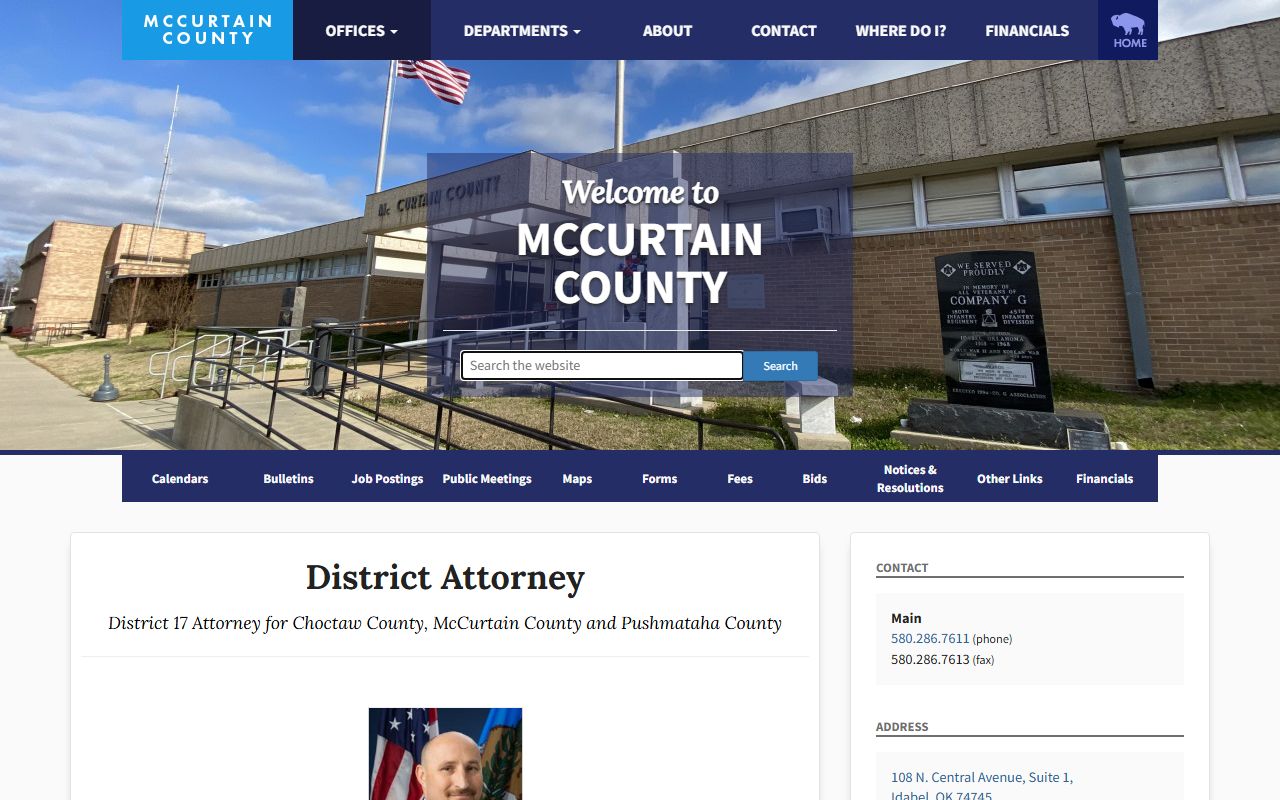
Mark Matloff is the District Attorney for District 17, which covers Choctaw, McCurtain, and Pushmataha Counties. The office prosecutes felony and misdemeanor charges, makes plea offers, and recommends sentences to the judge. For questions about a charging decision, a dropped count, or a plea, the District Attorney's office is the source, while the court clerk's docket is the public case file. You can read the office details and district coverage on the county District Attorney page.
The prosecutor's choices shape the whole file. A charge can be amended to a lesser offense, and that change shows in the docket. A weak count can be dismissed before trial. For appointed counsel, defendants should ask the assigned District Court, the judge, or the court clerk about the local process, since no separate public defender office is listed for the county.
How to Search McCurtain County Criminal Court Records
The main self-search path is On Demand Court Records, known as ODCR. The McCurtain County Court Clerk points the public to ODCR for District Court cases from 1998 to the present. You can search by a defendant's name or by case number, then open the case to read the docket and the disposition. A second statewide tool, the Oklahoma State Courts Network, hosts dockets, reports, and appellate material.
- Open ODCR and choose McCurtain in the court dropdown to limit results to the county District Court.
- Search by party name in Last, First form, or enter a full case number when you have one.
- Narrow the results with the case-type and date controls, picking Criminal Felony, Criminal Misdemeanor, or Traffic as needed.
- Open the case to read the docket entries, the charges as filed, and the disposition and sentence.
- Request a certified copy from the court clerk when you need a file-stamped document for legal use.
For older files or a search that returns nothing online, the court clerk runs a manual search. The fee is $5. You can ask by mail, by email, or in person, and a mailed reply needs a self-addressed stamped envelope. Bring or send the name, the year or year range, and any detail you have. Statewide users can also try the OSCN docket search, which lets you search by court, case number, or party. Note: ODCR and OSCN are public convenience databases, and Oklahoma rules state the official court file controls if the online data and the clerk's record ever conflict.
Stages of a McCurtain County Criminal Case
A criminal case moves through set steps, and each step leaves a mark in the record. The file opens when the prosecutor files the charging document, called an information. From there the case runs through a first appearance, pretrial work, a plea or a trial, and then sentencing if there is a conviction. Reading the docket in order is the best way to see where a case stands and what the court has done so far.
Case flow: Charges Filed › Arraignment › Pretrial / Motions › Plea or Trial › Disposition › Sentencing
| Stage | What Happens |
|---|---|
| Charges Filed | The District Attorney files the information that lists each count, the statute, and the offense date. |
| Arraignment | The court reads the charges to the defendant, who enters a plea, and the judge sets bond. |
| Pretrial / Motions | Lawyers file motions, share evidence, and ask for rulings, and many cases settle at this stage. |
| Plea or Trial | The defendant pleads, or the case goes to trial before a judge or a jury. |
| Disposition | Each count gets an outcome, such as guilty, not guilty, dismissed, or deferred. |
| Sentencing | After a conviction the judge orders the punishment and the docket records it. |
What a McCurtain County Criminal Court Record Shows
A criminal case file holds a set of standard fields. Some sit in the case header, some attach to each count, and some appear as dated docket lines. The header names the court, the case number, and the parties. The count section lists the charge as filed, the statute, and the offense date. The docket then tracks every event, from the first filing through bond, hearings, and the final order. The table below maps the core fields to what each one tells you.
| Field | What It Shows |
|---|---|
| Case Number | The court's unique ID, with a prefix such as CF, CM, or TR, plus the year and a sequence number. |
| Case Style | The title of the case, normally State of Oklahoma versus the named defendant. |
| Parties | The State of Oklahoma as plaintiff, the defendant, and the attorneys for each side. |
| Arresting Agency | The police, sheriff, or trooper agency that made the arrest, when listed. |
| Counts / Charge as Filed | Each charged offense by number, name, and description as the prosecutor filed it. |
| Statute Citation | The Oklahoma law cited for each count. |
| Offense Date | The date the charged conduct is said to have happened. |
| Bond | The money or conditions set for release and any later bond changes. |
| Warrant Status | Any warrant of arrest issued in the case, such as a bench warrant for a missed date. |
| Plea | The defendant's formal answer, such as guilty, not guilty, or no contest. |
| Disposition | The current or final outcome of each count. |
| Sentence | The punishment ordered after a conviction. |
| Docket Entries | The dated log of filings, hearings, orders, and fees in the case. |
Some docket lines point you to paper. An entry may read "Document Available at Court Clerk's Office" rather than offer a free download. In those cases the full filing is read or copied at the courthouse. Public dockets also leave out sensitive data such as Social Security numbers and full dates of birth, and copies can be redacted. For the charging side of the file on its own, the McCurtain County court charge records page breaks down the counts, codes, and how a charge can change.
Charges vs. Convictions
Being charged is not the same as being convicted. A charge is an accusation. A conviction is a finding of guilt by plea or by verdict. A criminal court record can show charges that were later dropped, dismissed, or ended in acquittal, and those counts still sit in the public file. Reading a case the wrong way can label a person as guilty when the court never found guilt. The split below is the safe way to read a count.
| Charge | Conviction | |
|---|---|---|
| Stage | Accusation by the prosecutor | Verdict or guilty plea |
| Burden of Proof | Probable cause | Beyond a reasonable doubt |
| Means Guilt | No | Yes |
| Public Record | Yes | Yes |
Reading Dispositions and Sentences
The disposition is the outcome the court assigns to a count. Common dispositions include guilty, not guilty, dismissed, and deferred. A no contest plea, also written as nolo, lets a defendant accept the result without admitting the act. A deferred sentence is a special path. The defendant enters a plea, the court sets conditions, and the case can be dismissed if the conditions are met. That outcome reads very differently from a straight guilty finding.
The sentence is the punishment ordered after a conviction. A McCurtain County criminal record can list jail or prison time, probation, fines, court costs, and restitution. Probation is a supervised term served in the community. If a defendant breaks the terms, the file may show a revocation, which is a proceeding to cancel probation or a deferred sentence. Reading the docket in date order shows whether a sentence was served, modified, or revoked, and which count each part of the sentence ties to.
Sealed vs. Expunged Criminal Records
Two terms get mixed up often. A sealed record is hidden from ordinary public view by law or court order. An expunged record is removed from public access and treated, for most purposes, as if it never existed. Oklahoma sets out who qualifies and how the process runs. The lead-in to read first is the state expungement statute, and the table after it lays out the basic split.
The Oklahoma statute that governs this is found at 22 O.S. 18, which lists the categories of arrest and court records that may be expunged or sealed.
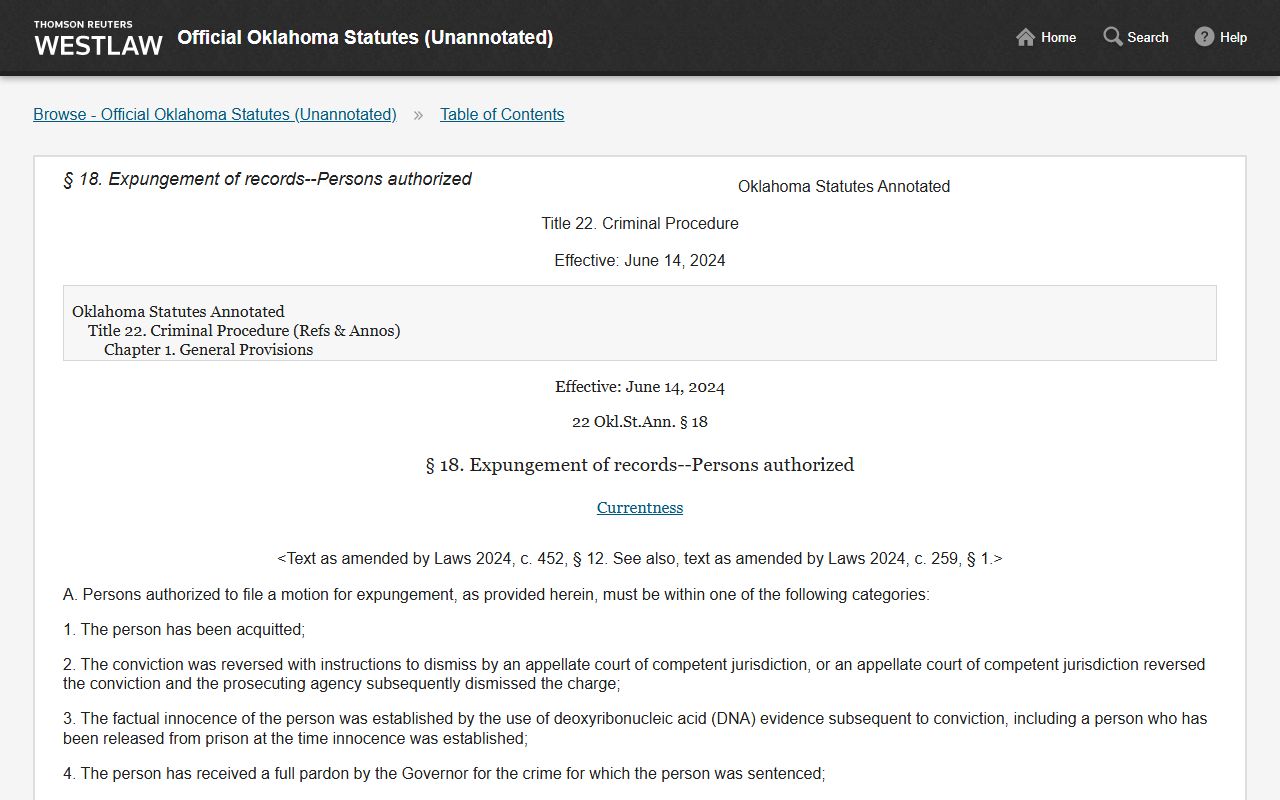
That statute is the broad tool for sealing both arrest and court records when a person fits a qualifying category. A second path under 991(c) applies after a deferred sentence. It can update the court disposition to read the equivalent of a dismissal, but it does not erase the underlying arrest record. Knowing which path applies matters before filing.
| Sealed | Expunged | |
|---|---|---|
| Visibility | Hidden from public view | Removed and treated as never existed |
| Law Enforcement | Limited access remains | Very limited access |
| Oklahoma Path | Court order under 22 O.S. 18 or 991(c) | Full Section 18 arrest and court-record expungement |
The Oklahoma State Bureau of Investigation runs the arrest-record side of expungement. Its expungement process page explains the difference between a Section 18 expungement and a 991(c) update.
OSBI states that expunging a court record is free, but expunging an arrest record carries a $150 OSBI processing fee, paid by cashier's check or money order. Local police agencies may add their own processing fees. A person seeking expungement should first find the case in ODCR, OSCN, or through the court clerk, confirm eligibility, and file the right petition in the District Court where the case was heard. Note: this is general information, not legal advice, so verify eligibility with the official OSBI guidance before you file anything.
Public Access to McCurtain County Criminal Records
Most criminal court files in McCurtain County are open to the public. The court clerk states that all court records except juvenile, adoption, and mental health files are available for public inspection, and that local files run from the early 1900s to the present. Oklahoma law backs this access. The state Open Records Act sets the rule that public records are open for inspection and copying during business hours, unless a law makes a record confidential.
Key Statutes:
Oklahoma Statutes Title 51 § 24A.5 - public records are open for inspection, copying, or reproduction during regular business hours, with set exemptions.
Court of Criminal Appeals Rule 2.6 - the OSCN online case search is a public convenience database and does not replace the official case-management record.
To get a file-stamped paper copy, ask the court clerk. Plain copies cost $1 for the first page and $0.50 for each added page, and certification is $0.50. A certified copy is the version courts and agencies accept as official, since an uncopied screen print from a database is not. For all court files beyond criminal cases, the broader McCurtain County court records page covers the full set of options.
Federal Criminal Cases and McCurtain County
Not every serious case from McCurtain County stays in the county District Court. McCurtain sits in the U.S. District Court for the Eastern District of Oklahoma, which covers 26 counties. The U.S. Attorney's Office describes the district as entirely Indian country. Because of that status, some serious criminal matters from the county can be charged in federal court rather than in state court. Jurisdiction can turn on the offense, the location, and the parties involved.
Federal criminal files do not appear in ODCR or OSCN. They are tracked through the federal PACER and CM/ECF systems instead. A search that comes up empty at the county level does not always mean there is no case, since the matter may sit in the federal docket. The state and county pages on this site cover District Court files, while federal prosecutions are handled by the U.S. Attorney for the Eastern District of Oklahoma and read through the federal system.
Restricted Criminal Court Records in McCurtain County
Some criminal-related files are closed to the public even though most are open. Juvenile delinquent and deprived matters are kept by the court and shared only with people the law allows. Oklahoma sets these limits in statute. The key citations are 10A O.S. 2-6-101 and 10A O.S. 2-6-105, which keep juvenile records with the court and limit who may inspect them.
Adoption and mental health files are also excluded from the local public-inspection statement, so treat them as sealed. Records under a granted expungement drop out of public access by court order. Active investigations and some warrant material may be held back while a matter is open. For a person worried about an outstanding order, the McCurtain County warrant records page explains how to check and what to do next. When access is denied, the court clerk can confirm whether a file is restricted, sealed, or simply not online.
Important: This site is private and is not a consumer reporting agency under the FCRA, so its records cannot be used for credit, employment, tenant, or insurance screening.